50% off social media and search training courses for Bath business

City of BathIn celebration of the summer The Levels are offering all of our neighbours here in the city of Bath  50% off all social media and search training courses booked in August.

A summary of the courses included in this offer is listed below, but we try and make sure every training course we deliver is tailored exactly to your needs (no sausage factory here!) so get in contact and we can discuss what will suit you best.

  1. An introduction to social media.  Getting up and running on Facebook and Twitter and making it pay for you. (1 Day course. Cost £500)
  2. The role of social media in your organisation.  An advanced course for businesses already using social media channels but wanting to better unite their on and offline activity and harmonise social media activity. (1Day course. Cost £750)
  3. An introduction to search engine marketing. How to use search engines to boost traffic and sales to your website and business.     (1 Day course.  Cost £500)
  4. How to write for search. A half day course that teaches you how to write content for your website that is super search friendly and will attract the maximum number of new customers to your website and business.  (1/2 day course. Cost £300)

Google take on the content farms with new update

image of a farmerYesterday ( Feb 23rd 2011) Google announced a major algorithmic change.  Although they haven’t given this one an official name many in the SEO space have nicknamed it “Farmer” (more of that later).   Google  admit the change will have a significant affect on the search results we see, impacting almost 12% of their US queries.  So, why the change?

In the company blog post Matt Cutts writes “this update is designed to reduce rankings for low-quality sites—sites which are low-value add for users, copy content from other websites or sites that are just not very useful.”  In our analysis this looks very much like they’ve declared war on the content farms.

Content farms produce articles based on keywords that are highly trafficked.  They respond to the changes in search behaviour and churn the stuff out.  Generally, it’s badly written filler guff that’s only there to grab the attention of the search engines and offers no real or tangible value to the readers.   In other words it’s spammy as hell!

This has been a long time coming, some insiders report that Google engineers have been working on this update for over 18 months.  With a initial roll-out to the US announced we’re hoping that this will eventually roll out to the rest of the world.

Cutts adds, “we’re very excited about this new ranking improvement because we believe it’s a big step in the right direction of helping people find ever higher quality in our results.”

So, lessons to take from this?  Invest in the content at your site, get your staff blogging, find an advocate and give them a voice.  Think about how you’re going to deliver useful, vibrant and search friendly content that’s a true resource for your customers and will serve you well in the future.

Using a content farm might seem like a convenient and cheap alternative but remember when we used to say that about buying links back in the day?

If you’d like to talk to us at The Levels about putting together a content strategy and delivering  training your staff to write effectively for search then just give us a shout at lucy@the-levels.com.

To read the blog post in full go to http://googleblog.blogspot.com/2011/02/finding-more-high-quality-sites-in.html

As Apple force through their 30% tax will we see a new “beer and sandwich” culture emerge?

Bad apple image For those of you who’ve had your attention to digital media distracted by events playing out in the Middle East and New Zealand then it may be news to you that Apple intend to charge publishers to it’s iPad and iPhone platforms a whopping 30% of subscription revenues.

The plan proposed by Apple would require that those who wish to distribute their online content to iOS devices (which includ the iPad and iPhone) would be required to offer users an option of subscribing directly from their application.

Apple would then take nearly one-third of the selling price for the online product. Previously, users had been able to purchase products through their Internet browser and sidestep Apple. The publishers were then able to collect 100% of the revenue from their sales. Also, links within apps to purchase products in this manner will be banned as of the 30th of June.

Publishers in the UK and US have reacted angrily to the proposed “tax” and there have been lots of suggestions that Apple are about to back down.  But we at the The Levels think that this is the very last thing that they’ll do.

The power has shifted and publishers better get used to that.  As the divine Pete Cashmore says ” unless a media company is able to build a better tablet or a better phone or convince customers to return to paper magazines and newspapers, nothing changes the fact that the publishing industry has lost control of its most valuable asset: distribution. It was always the printing presses and the delivery trucks, not the words themselves, that were the seat of the publishing industry’s power. The audience has moved elsewhere,”

So, for the smaller and niche publishers the 30% tax is going to be a reality.  But, we also anticipate that there may be more than a few back room beer and sandwich deals going on between Apple staff and the heavy weight publishers.

For some like News Corp there will always be a deal to be done that doesn’t involve handing over vast amounts of revenue to Apple and for others like Conde Nast there are advantages even to Apple to be associated with key influencer titles such as Vogue and GQ.

Smaller publishers saw the iPad as the answer to many of their collective dreams, and launched headlong into their perceived nirvana forgetting that Apple operates a closed walled garden that’s in place for a reason.    Apple are now cashing in on their dreams.

So, I guess the choice for the smaller player is either pay up or flip flop your way to Android.  And for the big guns, cheese & pickle and a pint of Bass it is then!

Blogging falls away in the US as teens turn increasingly to Facebook and Twitter

What have you done with your life imageIn the UK we love to blog, but we’re also (horribly) aware that for the majority of time no one’s bothering to read our daily out-pouring on what ever subject’s close to our heart.  Does it matter that on one cares?  Is a blog just the modern day equivalent of “Dear Diary”? It would seem that in the US  it’s not just enough to express yourself any-more you need an audience to cheer you on.

The Internet and American Life Project at the Pew Research Centre found that from 2006 to 2009, blogging among children ages 12 to 17 fell by half; now only 14 percent of children those ages who use the Internet have blogs.  Kids who used to blog gave various reasons for why they’ve stopped including lack of time, lack of inspiration and lack of readership.  But crucially, they also said that they’ve got no need to blog now that all of their friends are on Facebook.

But is it the case that we’re losing our creativity or that we’re just changing the way we publish our inner most thoughts?  You could make the argument both ways.  We could say that Twitter is restrictive at only 140 characters and that Facebook’s breeding a generation of kids with little to no attention span who’s only ability to critique what they read is to “like” it.

On the other side of the argument Twitter, Facebook et al are giving teenagers the tools to discover their own voice, to pontificate on the issues that are important to them and share these thoughts with their friends and families.

Lee Rainie, director of the Internet and American Life Project, says that blogging is not so much dying as moving with the times.

“The act of telling your story and sharing part of your life with somebody is alive and well — even more so than at the dawn of blogging,” Mr. Rainie said. “It’s just morphing onto other platforms.”

This change in behaviour can be seen in the traffic and users on the established blogging platforms. Blogger, (owned by Google) saw a 2% year on year decline in traffic in the US alone.

So, here are The Levels what do we think?  We’ll, we could get all high and mighty and say that Facebook killed the blogging star that we’re turning into a society that can’t construct a diary entry let alone an essay or god forbid a novel.  But, we actually think that teens are the lucky ones.  They can speak to the masses via their Twitter account, share their passions, their disappointments and their joys and most importantly find their voice.

Read the full report at http://www.pewinternet.org/Reports/2010/Generations-2010.aspx

Google Search Results Get More Social

Google social imageGoogle is taking its biggest step yet toward making search results more social.

Yesterday Google announced that it’s search results would now incorporate much more information from your friends and colleagues across your social networks.   Although Google remains by far and away the most dominant search engine in the UK this move comes as we are increasingly looking to our social networks for advise and validation.

“Relevance isn’t just about pages — it’s also about relationships,” Mike Cassidy, a Google product management director, and Matthew Kulick, a product manager, wrote in a Google company blog post this week as they discussed the new functionality.

Google has had a version of social search since 2009 but only a small percentage of people used it. Now, they’re enabling you to get even more information from the people that matter to you, whether they’re publishing on YouTube, Flickr or their own blog or website.

If you decide to switch social search on then these search results will now be mixed throughout your results based on their relevance, results (so only if you’re logged in to your Google account and have connected your social networking accounts).  The results will also be more comprehensive and will add notes for links people have shared on Twitter and other sites.  Google have also given you more control over how you connect accounts, and made connecting accounts more convenient by added a new option to connect accounts privately via your Google Account.

But how relevant is this move when Facebook results will be excluded?  The company blog post says social results will appear only “if someone you’re connected to has publicly shared a link.” As we know, Facebook posts are generally private, and Facebook in the past has made it almost impossible for Google to import social information.

So, thank you Google a nice move but how many people will bother to use this when by far the biggest social network isn’t taking part?  We’ll wait and see.

To read the full blog post:

http://googleblog.blogspot.com/2011/02/update-to-google-social-search.html


Is Twitter just for Tw*ts? Or why politics needs to change its conversation.

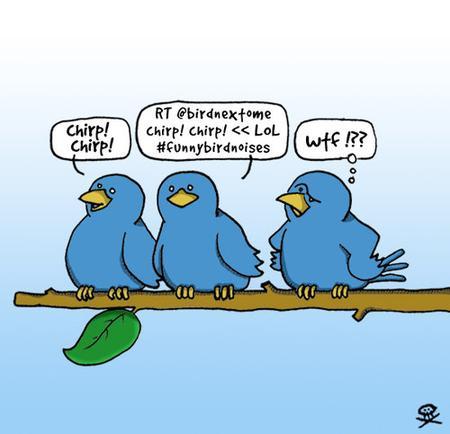
Twitter joke image of birdsDavid Cameron famously joked on national radio that “Too many twits make a tw*t”.  His comment has been re-hashed and derided too many times for us to make yet another unwanted aside here, but put his comment into the context of what’s happening across the Middle East and we start to see something more important.

Is it the case that social media gives freedom of expression to the  people of the Middle East or that their politicians are so divorced from the new ways their citizens are communicating that they are unable to control them?   I can just see heads of state and monarchs around the region jumping to engage a “social media guru” – no really I can.  This is because what Egypt taught these repressive leaders is that you can’t switch off the internet completely, people find a way.

So, instead of killing the channels, these leaders are (rather frighteningly) getting to grips with them.  They now know that they need to engage with them, not in a friendly conversational way, but in the form of censorship, bullying and intimidation.

In the western democracies our politicians also need to  look at the way they are speaking with us and in particular how young people are gathering their news and forming opinion.   With so much voter apathy and disenchantment with mainstream politics  it’s vital that they use channels correctly and with consistency.

In other words David, the only tw*ts I can see here are the governments who fail to grasp how these communication channels are changing the world around them.  In the extreme this allows Twitter to help fuel a revolution , but closer to home it means another generation of our young people who feel that their future is not in their hands and “why vote?” because it makes no difference?

Welcome to The Levels

Stop or I'll Tweet image Well, welcome to our blog. It’s taken us a month since we launched the business back in January to get ourselves up and running but here we are.

And what a month it’s been. We’ve seen social media take centre stage at the very heart of national revolutions.

Clay Shirky wrote “No one claims that social media makes people angry enough to act.  But it does help angry people coordinate their actions.”  He couldn’t have been any more correct when it came to the events that unfolded in Egypt.

We promise that we’ll up updating the blog on a much more regular basis but for now have a quick flick through and let us know what you think.